When life feels intense, it’s easy to think, “I should be calmer,” and then feel discouraged when you’re not. Mindfulness offers a different perspective: your reactions are not failures, but natural responses from a nervous system trying to protect you.
Mindfulness as a Friendly Companion to Your Nervous System
Practicing mindfulness doesn’t mean forcing yourself into relaxation. It means becoming familiar with how your body and brain respond, and learning simple ways to support them with care.
In this article, we’ll explore how mindfulness affects the nervous system and offer practices you can try today. No previous experience is required, and there is no need to “do this perfectly.”
A Gentle Tour of Your Stress Response
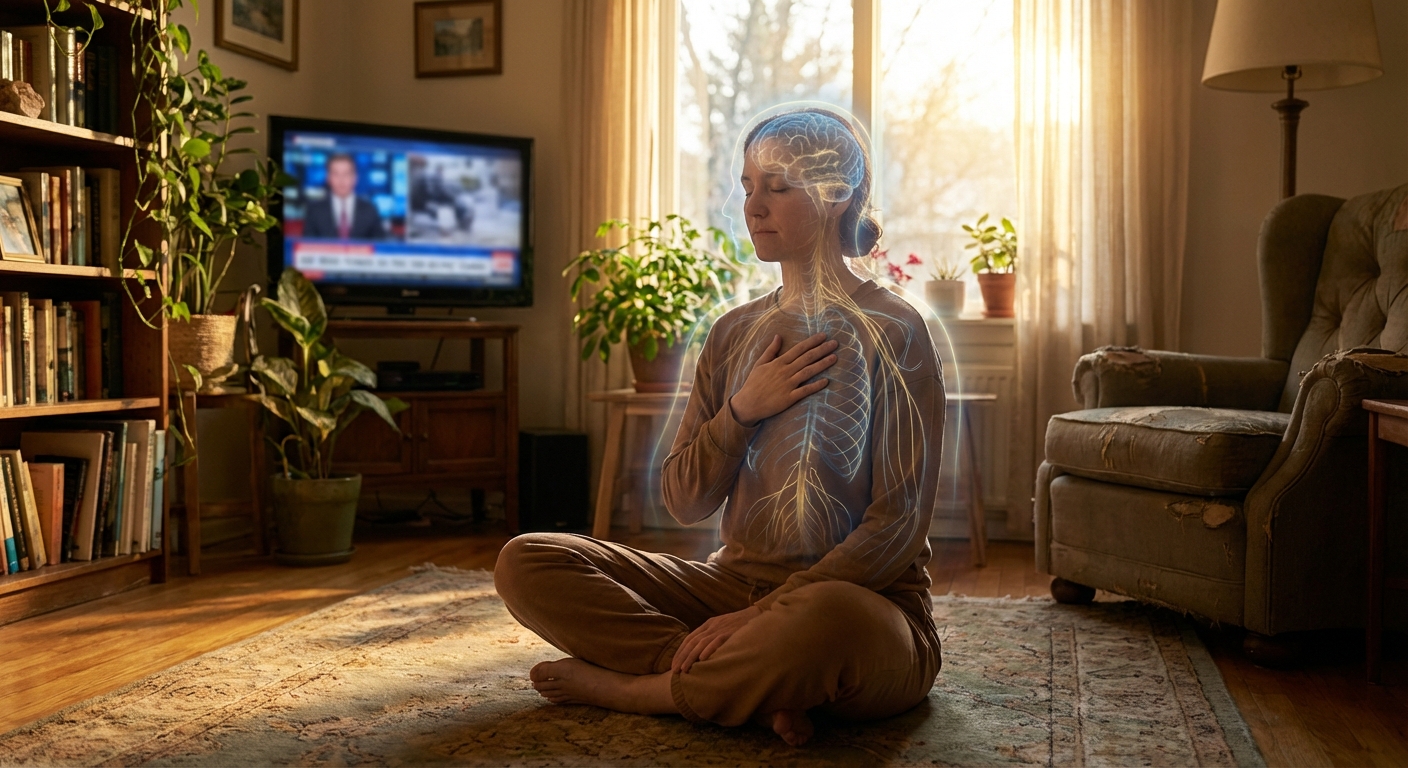
Your nervous system has two main modes:
- Sympathetic activation: Often called “fight or flight,” this mode prepares you to act—heart rate increases, breathing quickens, muscles tense.
- Parasympathetic activation: Often called “rest and digest,” this mode supports recovery—heart rate slows, digestion resumes, muscles soften.
Both modes are essential. Problems arise when the stress response stays on for too long or activates too easily.
Where Mindfulness Comes In
Mindfulness helps you:
- Notice early signs of activation (tight chest, racing thoughts)
- Recognize patterns without shame or blame
- Use simple practices to gently engage your parasympathetic system
Research shows that regular mindfulness practice can reduce activity in the amygdala (your brain’s alarm system) and strengthen the prefrontal cortex (involved in regulation and wise decision-making).
You don’t need to memorize these brain regions. It’s enough to know: you can influence your stress response through kind awareness and practice.
Practice 1: The Elongated Exhale
Breathing is one of the most direct ways to interact with your nervous system. When you lengthen your exhale, you stimulate the vagus nerve, which supports parasympathetic activation.
Try this 2-minute practice:
- Sit or lie down in a comfortable position.
- Inhale gently through your nose for a count of 4.
- Exhale softly through your mouth for a count of 6 or 8.
- Continue for 8–10 breath cycles.
If counting feels stressful, instead notice your natural breath and see if you can let your exhale be just a little longer, like a soft sigh.
While you breathe, you might silently say:
- Inhale: “Breathing in, I arrive.”
- Exhale: “Breathing out, I soften.”
You’re not forcing calm; you’re inviting it.
Practice 2: Grounding Through the Body
When your mind races, your body can become an anchor.
A 3-minute grounding scan:
- Feet: Notice your feet on the ground. Feel the contact—pressure, temperature, texture.
- Seat: Feel the weight of your body supported by the chair, cushion, or bed.
- Hands: Notice where your hands are resting. Let them soften.
You can silently repeat, “Here are my feet. Here is my seat. Here are my hands.”
This kind of body awareness strengthens interoception—the ability to sense internal states—which research links to emotional regulation and resilience.
Practice 3: Name It to Tame It
A simple, science-supported way to calm emotional intensity is affect labeling—putting feelings into words.
When you feel a strong emotion:
- Pause, if possible.
- Gently name what’s present: “Sadness is here,” “Anger is here,” “Fear is here,” “Numbness is here.”
- You might add, “A part of me feels…” to remind yourself this is not all of who you are.
Brain imaging studies suggest that naming emotions can reduce amygdala activity and increase engagement in regions associated with regulation. Practically, it can feel like turning on a small light in a dark room.
You’re not trying to get rid of the feeling—only to acknowledge it with kindness.
Why Kindness Matters More Than Control
Many people approach mindfulness as another way to control or eliminate unwanted experiences. This often leads to more tension.
A compassionate approach is different:
- Instead of, “I must calm down,” try, “I notice my body is activated; can I offer it some support?”
- Instead of, “I shouldn’t feel this way,” try, “Of course I feel this; this is a lot to hold.”
Self-compassion practices have been shown to reduce stress hormones, increase heart-rate variability (a marker of nervous system flexibility), and support healthier coping over time.
You can experiment with a simple phrase when you’re activated:
“This is hard.
I’m not alone in feeling this.
May I be as kind to myself as I would to a dear friend.”
A Short, Integrated Practice (5–7 Minutes)
When you have a few minutes, you can combine breath, body, and emotional awareness.
Settle (1 minute)
Sit comfortably. Feel your feet on the floor and your seat supported. Take two or three natural breaths.
Breathe (2 minutes)
Use the elongated exhale: inhale for 4, exhale for 6–8, or simply let your out-breath be a bit longer. Notice any small shifts in your body.
Body check (2 minutes)
Gently scan from head to toe. Wherever you find tension (jaw, shoulders, stomach), silently say: “It’s okay to be here,” and invite softening. If softening isn’t possible, just acknowledge, “Tension is here.”
Emotion naming (1–2 minutes)
Ask yourself, “What emotion is most present right now?” Name it softly. Place a hand where you feel it most and offer yourself one kind phrase, such as “I’m here with you.”
If at any point this feels overwhelming, you can open your eyes, look around the room, and reorient to something neutral or pleasant you can see.
Honoring Your Pace
Every nervous system has its own history and sensitivity. What feels soothing to some may feel activating to others. You are always invited to:
- Shorten or modify practices
- Skip steps that don’t feel right
- Return to simple grounding, like feeling your feet, whenever needed
Mindfulness is a relationship with yourself that develops over time. There will be days when it feels easier, and days when your system is too stirred up to settle much at all. Both are part of the practice.
What matters most is not the exact technique, but the quality of attention you bring: interested, gentle, and free from harsh judgment.
As you continue, you may notice small shifts—moments when you catch yourself before reacting, a little more space around a difficult feeling, a breath that arrives right when you need it. These are signs that your nervous system is learning it doesn’t have to carry everything alone or at full speed.
In those moments, you might quietly thank your body and mind for all the ways they’ve tried to protect you—and let mindfulness be a soft hand on the shoulder, walking alongside you, one breath at a time.