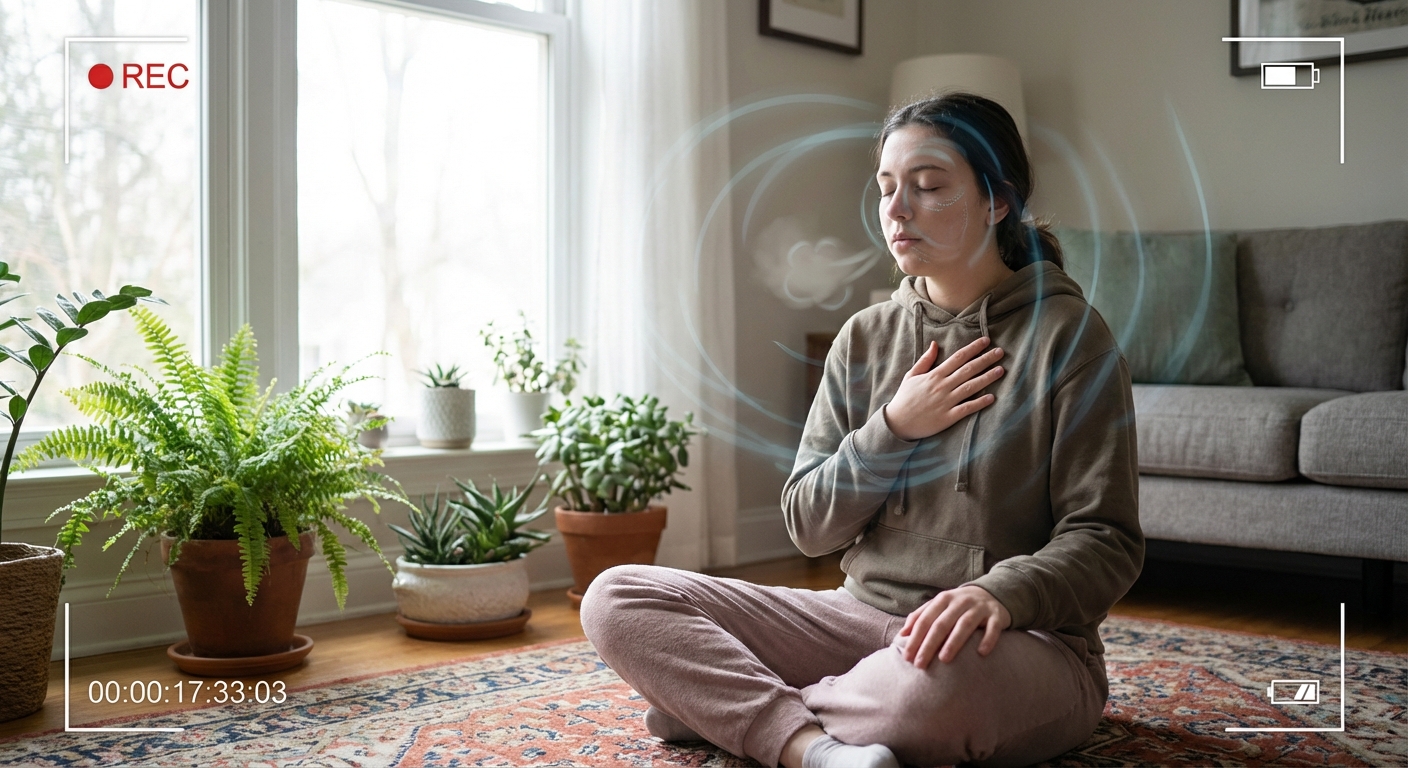
Many people imagine breathwork as something you do on a cushion, eyes closed, with plenty of quiet time. While that can be beautiful, it’s not the only way. Breathwork can also live in 30-second pauses between tasks, in a quiet moment at your desk, or in bed just before sleep.
Calm That Fits Into Real Life
This toolkit is for practitioners of all levels who want simple, flexible practices — from tiny “micro-moments” to slightly deeper sessions. You can choose the ones that fit your real life, exactly as it is.
There is no rush. Take what resonates, leave what doesn’t, and let your breath be a gentle companion rather than a project.
Part 1: The Smallest Units of Calm — 30 to 60 Seconds
Sometimes, a single minute is all you have. These practices are designed to slip quietly into your day.
A. The One-Breath Check-In
Where: Anywhere — at your desk, in the kitchen, in the car (parked).
How:
- Pause and feel your feet or the contact of your body with the chair.
- Take one slow, intentional inhale through your nose.
- Take one slow, complete exhale through nose or mouth.
- Silently ask yourself: “What is here right now?” You don’t have to answer.
This single breath is a small act of acknowledgment. You are reminding yourself that you exist beyond your tasks.
B. The 3-Breath Shoulder Softener
Where: At the computer, between messages or tasks.
How:
- Inhale slowly through your nose and shrug your shoulders gently toward your ears.
- Exhale through your mouth and let your shoulders drop, as if setting down a heavy bag.
- Repeat for a total of 3 breaths.
Notice the difference between the first and third exhale, even if it’s very subtle.
C. The 10-Count Exhale
Where: In moments of minor frustration or tension.
How:
- Inhale naturally through your nose.
- Exhale slowly through your mouth or nose, counting silently from 1 to 10.
- If you reach 10 before your exhale ends, just rest at 10 until the breath finishes.
This isn’t about making your breath long; it’s about giving your mind something simple and steady to rest on.
Part 2: Short Practices — 3 to 5 Minutes
When you have a bit more time, these practices can deepen the sense of calm and clarity.
A. The 4–6 Grounding Wave
Supportive for: Anxiety spikes, transition times, emotional waves.
How:
- Sit with your feet on the floor if possible. Feel the ground underneath.
- Inhale gently through your nose for a count of 4.
- Exhale slowly for a count of 6.
- Imagine each exhale as a small wave washing over tension in your jaw, shoulders, or belly.
Continue for 3–5 minutes, adjusting the counts to your comfort.
B. Breath-Body Scan
Supportive for: Reconnecting with your body, easing subtle tension.
How:
- Sit or lie down comfortably. Let your eyes close or soften.
- Take three easy belly breaths.
- Starting at the top of your head, slowly move your attention down through your body — forehead, eyes, jaw, shoulders, chest, belly, hips, legs, feet.
- At each area, feel one full inhale and one full exhale, noticing any sensations.
No need to change what you find. Simply acknowledging can gently soften held tension.
C. Counting Breaths to Ten
Supportive for: Focus, mental clarity, and easing rumination.
How:
- Sit comfortably with your spine relaxed and upright.
- Inhale naturally; as you exhale, count “one” in your mind.
- Next exhale, count “two,” and so on up to “ten.”
- If your mind wanders or you lose count (which it will), gently return to “one” without criticism.
Even 3–5 minutes of this practice can create a clear, steady feeling in the mind.
Part 3: Deeper Sessions — 8 to 15 Minutes
When you’re ready for a slightly fuller practice, these sessions invite deeper regulation of the nervous system. They remain gentle and accessible.
A. Coherent Breathing Session
Supportive for: Long-term stress resilience, emotional balance, preparing for or closing a meditation session.
How:
- Sit or lie down comfortably.
- Set a timer for 8–15 minutes.
- Inhale through your nose for 5 seconds.
- Exhale through your nose for 5 seconds.
- If 5 seconds feels too long, try 4 in and 4 out.
Let your attention rest on the smoothness of the rhythm rather than the numbers themselves.
B. Gentle Evening Unwind
Supportive for: Transitioning from day to night, easing into sleep.
How:
- Dim lights and find a comfortable lying or seated position.
- Take 5 normal breaths to arrive.
- For the next 5 minutes, practice 4–6 breathing (inhale 4, exhale 6).
- For the final few minutes, let go of the counting and simply feel the breath as a soft rocking motion.
If sleepiness arises, you can let yourself drift.
C. Compassionate Breath Practice
Supportive for: Emotional heaviness, self-criticism, feeling disconnected from yourself.
How:
- Sit comfortably, perhaps placing a hand on your heart or belly.
- Inhale gently through your nose, imagining that you’re breathing in kindness.
- Exhale slowly, imagining that you’re breathing out tension, harshness, or fatigue.
- Silently repeat a simple phrase with each exhale, such as, “May I be gentle with myself.”
Continue for 8–10 minutes, allowing the words and breath to soften any edges inside.
Working With Common Challenges
Breathwork doesn’t always feel instantly soothing. You might notice restlessness, boredom, or even discomfort at first. This is not a sign of failure; it’s simply your system adjusting.
A few supportive suggestions:
- If you feel light-headed: Return to your natural breath, open your eyes, and pause the practice.
- If focusing on breath is triggering: Alternate between breath awareness and external anchors (sounds, sights, the feeling of your hands on your legs). You can also keep practices very short.
- If your mind won’t quiet: Let go of the idea that it must. The practice is simply noticing and returning, again and again, with kindness.
You are not trying to force calm. You are offering your body and mind an opportunity to soften, at their own pace.
Building a Gentle Habit
If you’d like breathwork to become a regular part of your life, it can help to make it very small and very specific at first.
Consider choosing:
- One micro-practice (for example, a 3-breath shoulder softener), and
- One short practice (perhaps the 4–6 grounding wave)
Then pair them with existing routines:
- After you sit down at your desk, do your 3-breath shoulder softener.
- After lunch, practice the 4–6 grounding wave for 3 minutes.
This way, breathwork becomes woven into what you already do, rather than something extra you must remember.
Your Toolkit, Your Way
This toolkit isn’t meant to be completed. It’s meant to be returned to. On some days, you may only find space for a single slow breath; on others, a longer session may feel nourishing.
The real practice is not about mastering techniques; it’s about how you relate to yourself in each breath — with patience, curiosity, and as much kindness as you can muster.
Right now, before you move on, you might choose one practice from above and try it, briefly. Let your breath show you how even the smallest moments can hold a surprising amount of calm.