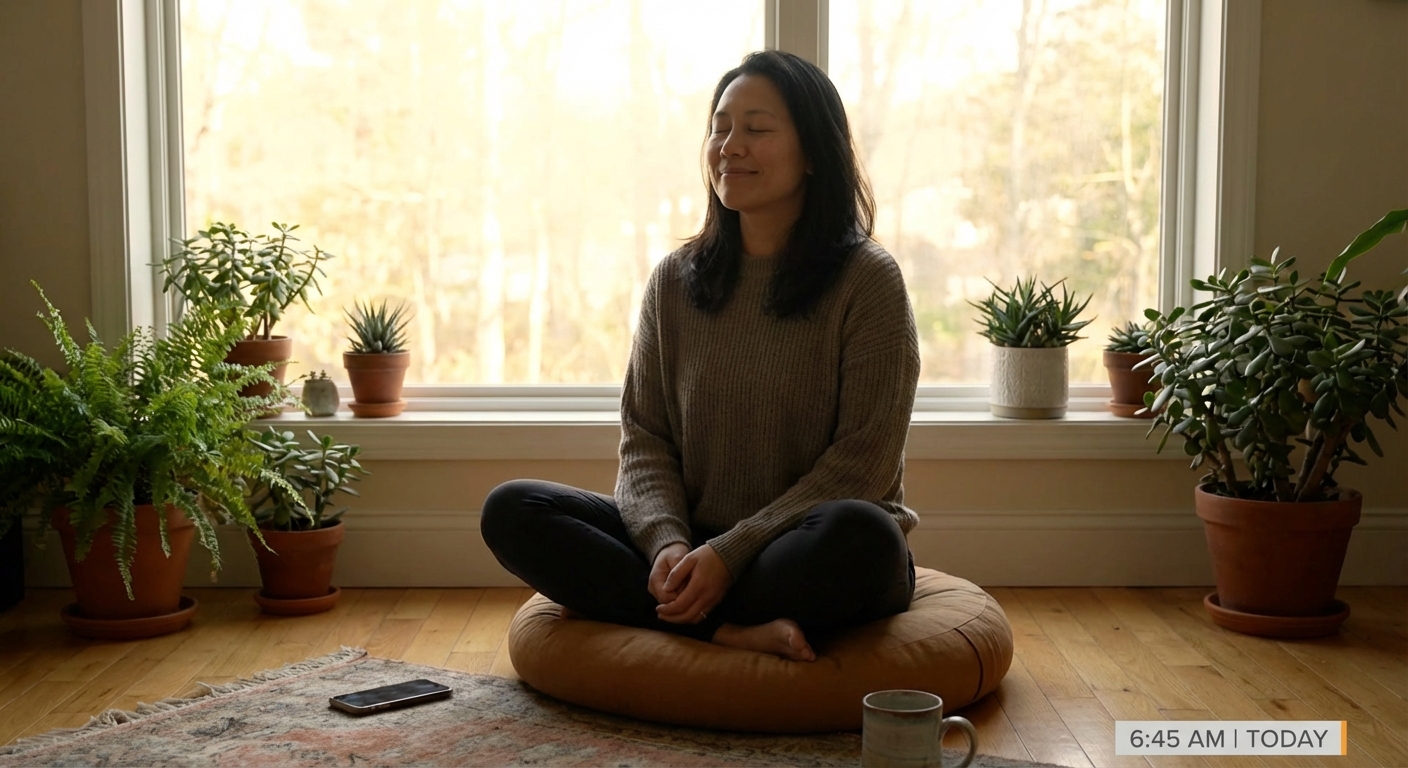
Life will always bring waves—deadlines, worries, unexpected changes, and the constant hum of responsibilities. Meditation does not remove these waves; it helps you learn to surf them with a little more steadiness.
Stress Is a Wave, Not a Verdict
Mindfulness meditation gives you tools to notice stress as it arises, to understand how it shows up in your body and mind, and to respond with care rather than automatic tension. You don’t need hours of practice or special training to begin softening stress; small, consistent moments of awareness are enough to start shifting your inner climate.
This article explores how meditation affects stress on a physiological and psychological level, and offers simple practices you can integrate gently into your day.
What Happens in Your Body When You’re Stressed
Stress isn’t just a feeling; it’s a whole-body response designed to protect you.
When you perceive a threat—whether it’s a looming email or a real danger—your sympathetic nervous system activates, releasing hormones like cortisol and adrenaline. Your heart rate increases, muscles tense, and attention narrows. This is the classic “fight, flight, or freeze” response.
Short bursts of stress can be useful. But when this system is activated for long periods, it can contribute to:
- Sleep disruption
- Digestive discomfort
- Headaches and muscle pain
- Irritability and fatigue
- Difficulty concentrating
Meditation, particularly mindfulness-based practices, has been repeatedly shown to support a shift toward the parasympathetic nervous system—the “rest and digest” mode associated with recovery, healing, and calm alertness.
How Meditation Softens the Stress Response
Research over the past few decades, including studies on Mindfulness-Based Stress Reduction (MBSR), has found that regular meditation can:
- Reduce perceived stress
Participants often report feeling less overwhelmed by the same life circumstances.
- Lower physiological markers
Some studies show reductions in blood pressure, heart rate, and even baseline cortisol levels.
- Change brain patterns
Meditation can decrease reactivity in the amygdala (a key fear and threat center) and increase activity in regions associated with regulation and perspective, such as the prefrontal cortex.
- Improve emotional regulation
Practitioners often become more aware of early signs of stress and can choose more skillful responses.
The core mechanism is simple: by repeatedly bringing attention to the present moment with non-judgment, you interrupt automatic loops of worry and rumination that feed stress.
A 7-Minute Body-and-Breath Practice to Meet Stress Gently
You can use this practice when you notice stress building, or as a daily ritual to support resilience.
1. Settle and acknowledge (1 minute)
Sit comfortably or lie down if that feels better. Let your hands rest gently.
Silently name what is present: "Stress is here", "Worry is here", or simply "Tension." You are not labeling yourself, only the experience.
2. Scan for tension (2 minutes)
Slowly move your attention through the body:
- Start at the forehead and eyes. Notice any tightness.
- Move down through the jaw, neck, and shoulders.
- Continue down the arms, chest, belly, hips, legs, and feet.
Wherever you find tension, imagine your breath gently touching that area on each exhale. You are not trying to force relaxation—just offering awareness and a quiet invitation to soften.
3. Extended exhale breathing (3 minutes)
Begin to lengthen your exhale slightly more than your inhale.
- Inhale through the nose for a count of 4.
- Exhale through the nose or mouth for a count of 6.
If counting feels stressful, simply notice the exhale as a little longer and smoother. This pattern engages the parasympathetic nervous system, signaling safety and allowing the body to recalibrate.
If any dizziness arises, reduce the length or return to normal breathing.
4. Close with kindness (1 minute)
Place a hand on your chest or belly. Offer yourself a compassionate phrase:
- "This is a stressful moment, and I am doing the best I can."
- "May I meet this stress with understanding, not judgment."
When you’re ready, open your eyes or lift your gaze. Notice any subtle shifts, even if they are small.
Micro-Practices for Stressful Moments
Not every stressful situation allows for a 7-minute pause. Here are brief, situational practices you can weave into your day.
1. The Email Pause
Before opening an email that you anticipate might be challenging:
- Feel your feet on the floor.
- Take 2 slow breaths with slightly longer exhales.
- Silently say, "I can read this with steadiness."
Then open the email, noticing the body’s reactions as you read.
2. The Transition Breath
Between meetings, tasks, or roles (such as shifting from work mode to home mode):
- Stand or sit tall.
- Inhale and gently roll the shoulders up toward the ears.
- Exhale and roll them back and down, letting go.
- Repeat 3 times, synchronized with your breath.
This marks a small but meaningful closure of one moment and arrival into the next.
3. The Hand on the Heart at Night
Before sleep:
- Lie on your back or side.
- Place one hand on your heart and one on your belly.
- Feel the warmth of your hands for 10–15 breaths.
- With each exhale, silently say, "Letting go for now."
You’re giving the nervous system a quiet message that, for this moment, it is safe to rest.
Meeting Resistance with Curiosity
Sometimes when we feel stressed, meditation can seem like one more thing on the to-do list. Or we may sit down and instantly want to get back up. This is very normal.
Try gently exploring resistance instead of fighting it:
- "What am I afraid might happen if I slow down for a few minutes?"
- "What belief is here—maybe that rest is not allowed or that productivity is everything?"
You don’t need to answer these questions right away. Simply asking them is a beginning.
Remember: even one mindful breath, taken fully, is a meaningful practice. There is no minimum time required to earn the benefits of presence.
Building a Softer Relationship with Stress Over Time
As you practice, you may notice subtle changes:
- You catch stress earlier, while it’s still a whisper.
- You become more aware of your body’s signals—tight shoulders, shallow breath, clenched jaw.
- You find small spaces between trigger and reaction, enough to choose a kinder response.
These shifts don’t mean you won’t feel stress. They mean stress no longer fully defines your inner experience.
Meditation helps you remember: you are the ocean, not only the waves.
A Gentle Next Step
If you’d like to continue, you might:
- Commit to the 7-minute practice once a day for a week.
- Choose one micro-practice to anchor to a daily activity, like brushing your teeth or making tea.
- Write a short note to yourself: "When I feel stressed, I am allowed to pause." Place it somewhere you’ll see it.
Let each breath be a soft tide, washing a little tension from the shore of your body and mind. Nothing forced, nothing perfect—just this moment, met with awareness and warmth.