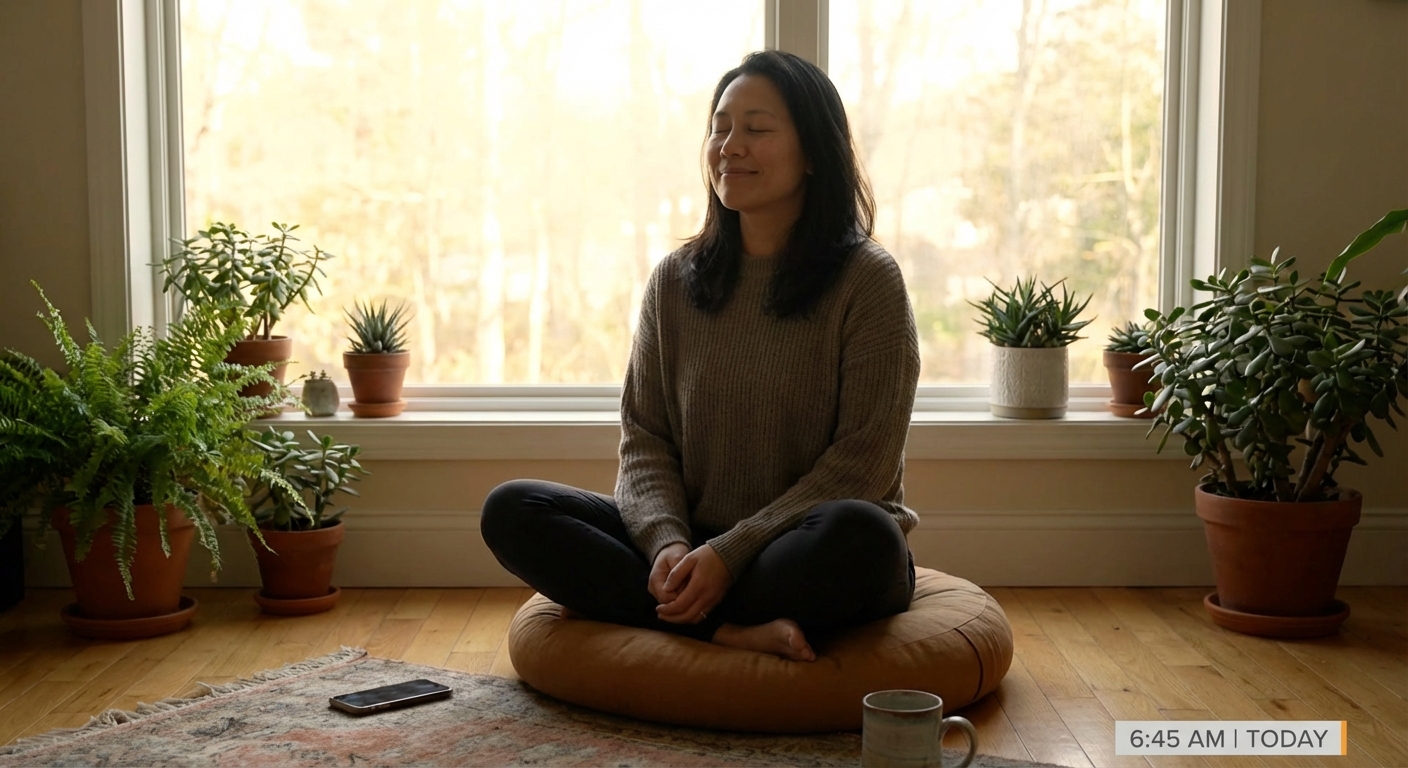
Many people come to meditation hoping to quiet a loud, critical inner voice. You may recognize it: the part that says you’re not doing enough, not meditating correctly, or not worthy of rest. This voice can be exhausting, even when it believes it is helping you improve.
When Your Mind Speaks Harshly
Meditation, especially when combined with self-compassion, offers a warm alternative. Rather than fighting the inner critic or trying to silence it, you learn to meet it with understanding, to soften its grip, and to cultivate a kinder inner tone.
This article explores how compassionate meditation can support you, what science suggests about the effects of self-compassion, and offers gentle practices suitable for beginners and experienced practitioners alike.
Understanding the Inner Critic with Kind Curiosity
The inner critic often develops as a strategy: to keep you safe, accepted, and successful. It may echo voices you heard growing up or internalized social expectations. While its methods can be painful, its deeper intention is often protection.
Seeing this does not mean you have to agree with it. Instead, you can begin to relate to this voice differently.
Ask yourself, softly:
- What is my inner critic afraid would happen if it relaxed?
- When does it speak the loudest—around work, relationships, appearance, or spiritual practice?
These questions are not a test; they are invitations to understand.
Self-Compassion: What the Research Shows
Self-compassion, a concept extensively researched in psychology, involves three core elements:
- Mindfulness – Noticing your struggles without exaggerating or minimizing them.
- Common humanity – Remembering that imperfection and difficulty are part of being human, not a personal flaw.
- Kindness – Responding to your suffering with warmth rather than harshness.
Studies on self-compassion practices, many of which are rooted in contemplative traditions, suggest they can:
- Reduce anxiety, depression, and shame
- Increase resilience in the face of setbacks
- Support healthier motivation (less fear-driven, more values-driven)
- Improve body image and emotional well-being
Meditation that consciously incorporates self-compassion helps rewire habitual patterns of self-judgment into more nurturing inner dialogue.
A 10-Minute Compassionate Meditation for the Inner Critic
You can try this practice seated or lying down. Please adjust or pause if anything feels overwhelming.
1. Arrive in the Body (2 minutes)
- Sit comfortably with your feet on the floor or lie down with a pillow under your knees.
- Feel your body supported by the chair, cushion, or bed.
- Take three slow, comfortable breaths, letting the exhale be slightly longer.
Bring attention to where your body contacts the ground or seat. Notice any sense of weight or support.
2. Gentle Mindfulness of Experience (3 minutes)
Begin by simply noticing what is present:
- Thoughts moving through
- Emotions in the background
- Sensations in the body
If you notice a harsh thought—"I’m not doing this right," "I can’t even meditate"—mentally label it: "Inner critic." No need to push it away or believe it; just notice.
If it feels okay, silently say, "I see you." You are acknowledging the critic’s presence without letting it run the show.
3. Placing a Hand on the Heart (1 minute)
Gently place one hand on your heart (or another soothing place, such as the cheek, belly, or upper arm). Feel the warmth and weight of your hand.
Let this gesture be a physical reminder of care. You’re signaling to your nervous system that it is safe to soften.
4. Offering Compassionate Phrases (3 minutes)
Silently repeat phrases that convey kindness toward yourself. Choose the ones that resonate, or adapt them in your own words.
- "This is a moment of difficulty."
- "Everyone struggles; I am not alone in this."
- "May I be kind to myself in this moment."
- "May I give myself the compassion I need."
If the inner critic interrupts—"You don’t deserve this"—simply notice: "Inner critic speaking." Then gently return to the phrases, as if you’re choosing which radio station to listen to.
5. Widening the Circle (1 minute)
If it feels comfortable, you can extend compassion outward:
- Bring to mind someone you care about who is also hard on themselves.
- Silently wish for them: "May you be kind to yourself. May you feel worthy of rest."
Remember that you, too, are included in this wish.
6. Closing with Gratitude (1 minute)
Before you finish, acknowledge: you just spent time turning toward yourself with care. That is not a small thing.
Silently say, "Thank you" to yourself for taking this time, even if part of you resisted.
Gently open your eyes or lift your gaze, carrying a trace of this warmth into the next part of your day.
Soft Responses to Common Concerns
“If I stop being hard on myself, I’ll become lazy.”
Research suggests the opposite: self-compassion tends to support sustainable motivation. When you respond to mistakes with curiosity instead of harshness, you are more likely to learn from them and try again.
You might experiment with this question: "What would I do next if I truly believed I was worthy of kindness and growth?"
“Compassion feels fake or uncomfortable.”
If kind words feel unnatural, that doesn’t mean they are wrong for you. It may simply reflect unfamiliarity. You can start more neutrally:
- "I’m noticing that I’m suffering right now."
- "It makes sense that I feel this way."
Over time, as your nervous system learns that it is safe to receive care, warmer phrases may feel more accessible.
“My inner critic gets louder when I meditate.”
Bringing awareness inward can initially highlight patterns that were previously in the background. This is not a setback; it is a sign of seeing more clearly.
If the critic becomes overwhelming, you can:
- Open your eyes and focus on an external object.
- Shift to a grounding practice, like feeling your feet or naming items in the room.
- Shorten your meditation and end with a simple, steadying phrase: "Right now, I am safe enough."
If strong self-critical or traumatic material arises, practicing with a skilled teacher or therapist can offer additional support.
Weaving Compassion Into Everyday Moments
You don’t have to wait for formal meditation time to practice.
- After a mistake: Pause. Breath in: "This is painful." Breath out: "May I be gentle with myself."
- In conversation: When you notice self-judgment ("I sounded foolish"), add a second voice: "I was doing my best with what I knew."
- At night: Place a hand on your heart and recall one small thing you did today that reflected care—for yourself or another. Let it register, even if part of you protests.
These are small acts, but over time, they accumulate, gradually reshaping the tone of your inner world.
You Are Not Meant to Be Your Own Enemy
Meditation is not only about attention; it is also about relationship—how you relate to your breath, your thoughts, your history, and your heart.
The inner critic may not disappear completely, but it can shift from a dominating voice to one of many, held within a larger field of compassion. You may still hear it, but you won’t mistake it for the whole truth about who you are.
Each time you pause, place a hand on your heart, and whisper something kind—especially when you feel you least deserve it—you are planting seeds of a new habit: being on your own side.
You don’t have to earn this kindness. It is available, right now, exactly as you are.